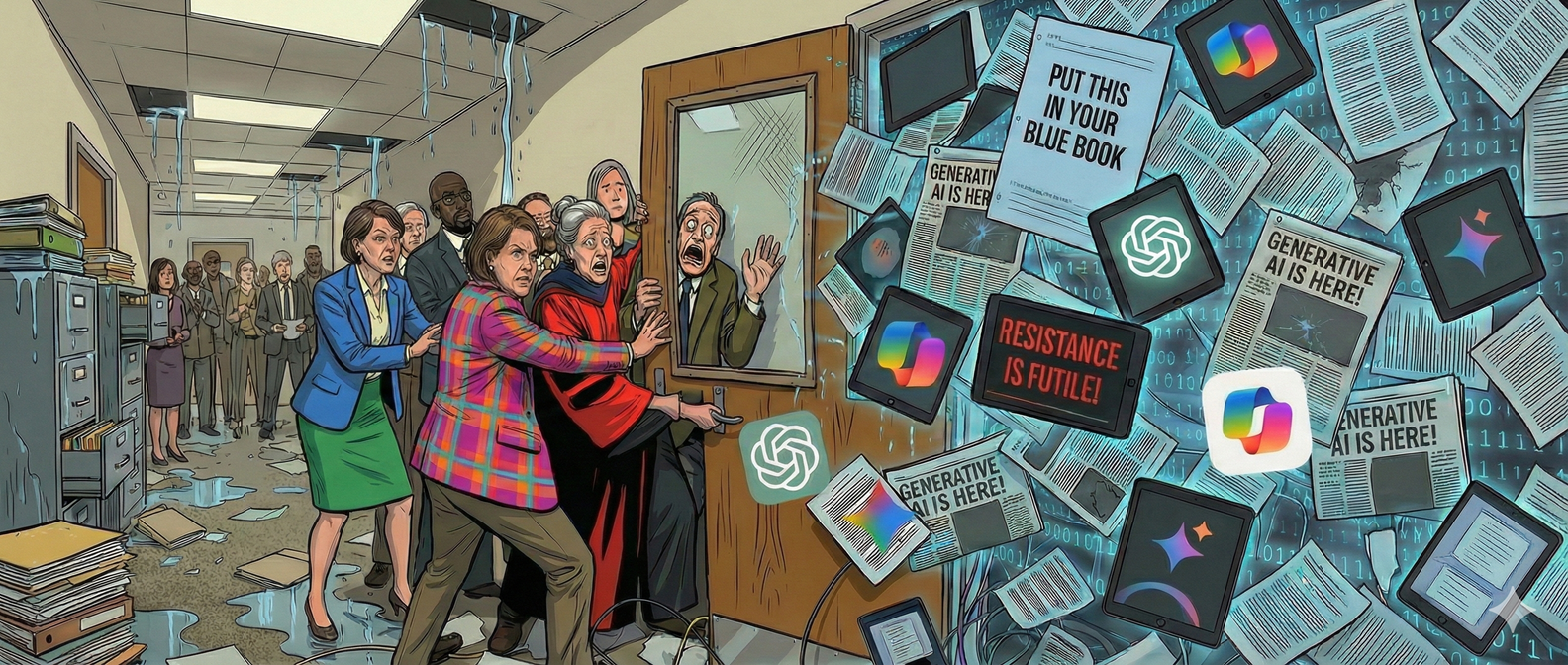
Finding our way out of a digital loop
By Doug Ward
The phrase “humans in the loop" has become a cliché for the importance of overseeing the processes and output of generative artificial intelligence.
By Doug Ward
The phrase “humans in the loop" has become a cliché for the importance of overseeing the processes and output of generative artificial intelligence.

By Doug Ward
Microsoft has recently added Copilot tools specifically for teachers.
By Doug Ward
Research about learning and artificial intelligence mostly reinforces what instructors had suspected: Generative AI can extend students’ abilities, but it can’t replace the hard work of learning. Students who use generative AI to avoid early course material eventually struggle with deeper learning and more complex tasks.
On the other hand, AI can improve learning among motivated students, it can assist creativity, and it can help students accomplish tasks they might never have tried on their own.
By Doug Ward
The KU version of Copilot now allows the creation of agents, which means you can customize Copilot and give it instructions on what you want it to do, how you want it to respond, and what format its output should follow.
By Doug Ward
The shock has worn off, but the questions about how to handle generative artificial intelligence in teaching and learning seem only to grow.
Those questions lack easy answers, but there are concrete steps you can take as we head into the third year of a ChatGPT world:
By Doug Ward
Kansas ranks near the bottom in the percentage of schools offering foundational computer science education, according to a study by Code.org, the Computer Science Teacher Association, and the Expanding Computing Education Pathways Alliance.
By Doug Ward
As I prepared to speak to undergraduates about generative artificial intelligence last October, I struggled with analogies to explain large language models.
By Doug Ward
We need to talk.
Yes, the conversation will make you uncomfortable. It’s important, though. Your students need your guidance, and if you avoid talking about this, they will act anyway – usually in unsafe ways that could have embarrassing and potentially harmful consequences.
So yes, we need to talk about generative artificial intelligence.
Nearly a decade ago, the Associated Press began distributing articles written by an artificial intelligence platform.
Not surprisingly, that news sent ripples of concern among journalists. If a bot could turn structured data into comprehensible – even fluid – prose, where did humans fit into the process? Did this portend yet more ominous changes in the profession?
Since its release late last year, ChatGPT has reverberated through the academic mind like an orchestral crescendo in a Strauss symphonic movement. It has amazing abilities, and even greater potential. Even so, it delivers many of its responses in a monotone reminiscent of HAL 9000, the rogue artificial intelligence system in 2001: A Space Odyssey.