By Doug Ward
I talk frequently about the need for faculty members to experiment with and adapt their teaching to generative artificial intelligence.
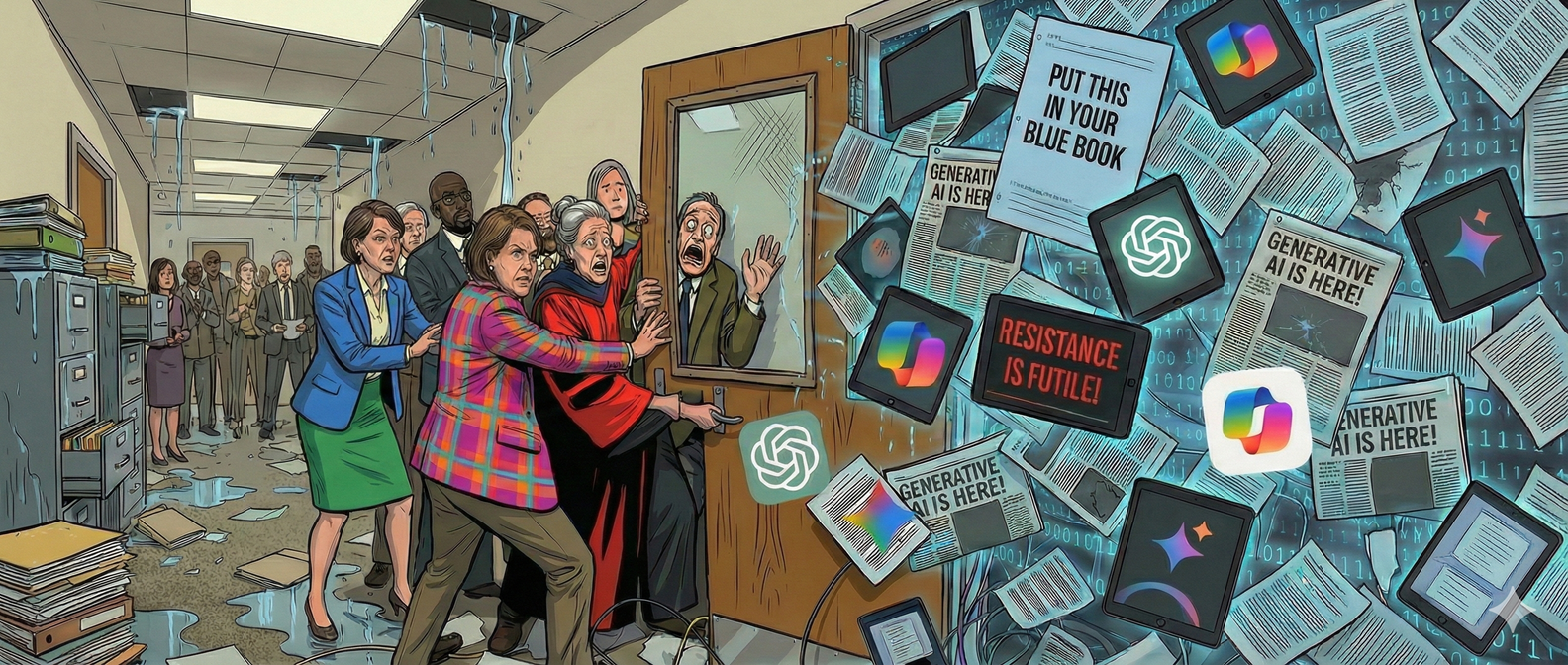
During a CTE session last week, an instructor mentioned how difficult that was, saying that “the landscape of AI is changing so rapidly that it seems impossible to keep up with.”
I agree. Not only that, but the rapid changes in generative AI seem to increase the pace of life. Daniel Burrus writes that “the world has shifted from a time of rapid change to a time of transformation.” That imposed change has pushed us to “react, manage crises, put out fires” rather than transform, which is something we do from within ourselves, he says.
My advice is to tune it out the flood of AI-related news. It’s important to understand the basic concepts of generative AI and to consider how you might take advantage of some of the tools. It is also crucial to talk with students frequently about use of generative AI, to help them understand how they might use generative AI on the job, and to help them develop AI literacy skills. You don’t have to keep up with every development, though.
Steps you can take
As the flood of news about generative AI roars past, try to ignore it. Instead, take a few steps that will empower both you and your students.
- Focus on a few tools. Find a generative AI tool you are comfortable with and stick with it. Learn how it works and what it can do. Start with Microsoft Copilot. It isn’t as powerful as some other tools, but it provides additional privacy and security when you log in with your KU credentials. It also allows you to create personalized chatbots called Copilot agents.
- It’s also worth learning to use NotebookLM, which allows you to create a folder of sources that Google’s Gemini draws on to answer questions. (Google says material in NotebookLM is not used in training generative AI models.) It is an excellent research tool, and it can serve as a learning tool for students if you upload course-related materials.
- Focus on your discipline. Rather than trying to keep up on the daily developments of generative AI, focus on the uses and the changes in your discipline. That will help cut through the noise.
- Learn with students. Instructors often feel uneasy about generative AI because it falls outside their area of expertise. Embrace that uneasiness and explain to students that everyone is trying to figure out where, how and whether this new technology fits into the work they do. Draw on the CTE generative AI course in Canvas. (Email dbward@ku.edu if you would like access.) Create exploratory assignments, have discussions about use of generative AI, and model a research mindset in helping students – and you – learn.
- Draw on CTE resources. Learn more about why students are drawn to generative AI and how you can adapt your classes to generative AI. Explore ways to integrate generative AI into your courses. Work with students on effective prompting. Try CTE-created tools for using Copilot agents, creating rubrics, and designing assignments. Join the Teams site on Generative AI in Teaching. It is a good place to ask questions and find information that we at CTE and others around campus share about developments in generative AI. (Contact dbward@ku.edu if you would like to be added to the site.)
Again, don’t try to stay abreast of everything related to generative AI. But do what you can to keep learning and adapting your courses.
Doug Ward is associate director of the Center for Teaching Excellence and an associate professor of journalism and mass communications.