As many educators in the United States and Canada have held back or retreated on adapting courses to generative artificial intelligence, those in the rest of the world have pushed forward.
The approaches are in some cases so divergent that a new report from the Digital Education Council sometimes reads like two reports about two different worldviews of higher education.
That’s an oversimplification. Faculty and students in all countries have a wide range of views about generative AI. In the U.S. and Canada, though, the number of faculty engaging with generative AI has declined, in a stark contrast to the rest of the world. Those faculty are also far more pessimistic about generative AI than their colleagues in other countries, and more confident that existing approaches to teaching will prepare students for the future.
Students’ views on generative AI suggest yet another reality. They, too, are worried about the future, and they often don’t see their instructors as capable of guiding them.
In an introduction to a report on the survey, Alessandro Di Lullo, the chief executive of the council, and Danny Bielik, the president, write that the results “should give leaders pause.”
“AI has moved into the mainstream of student and faculty life faster than institutions have been able to respond to it,” they said. “Adoption is now widespread, but coherent practice is not.”
The numbers behind the survey
The survey from the Digital Education Council aggregates responses from 27,284 students and 18,114 faculty in 35 countries. Those responses include KU, although results from individual universities have not been released. Here are a few snapshots:
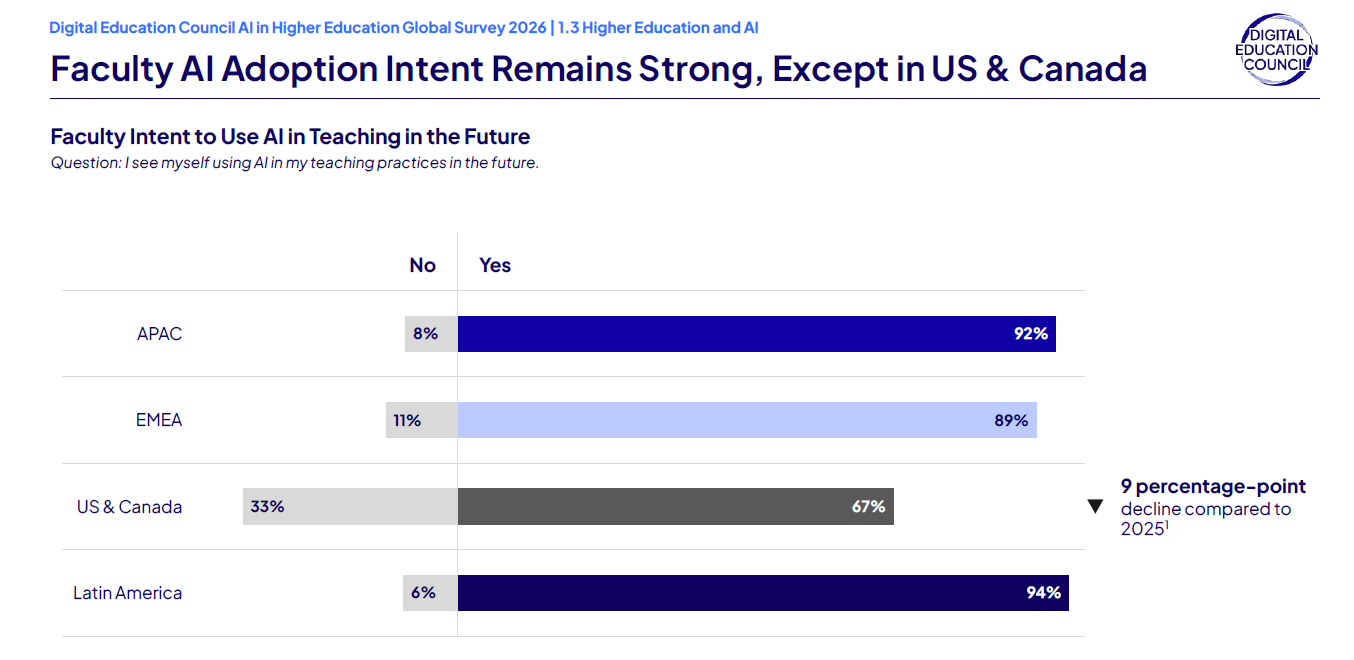
Use of AI. In the U.S. and Canada, 54% of faculty say they use generative AI in their teaching, compared with 82% in Asia-Pacific, 79% in Latin America, and 78% in Europe. Similarly, the percentage of U.S. and Canadian faculty who say they plan to adopt AI in the future has fallen 9 points in the past 18 months, to 67%.
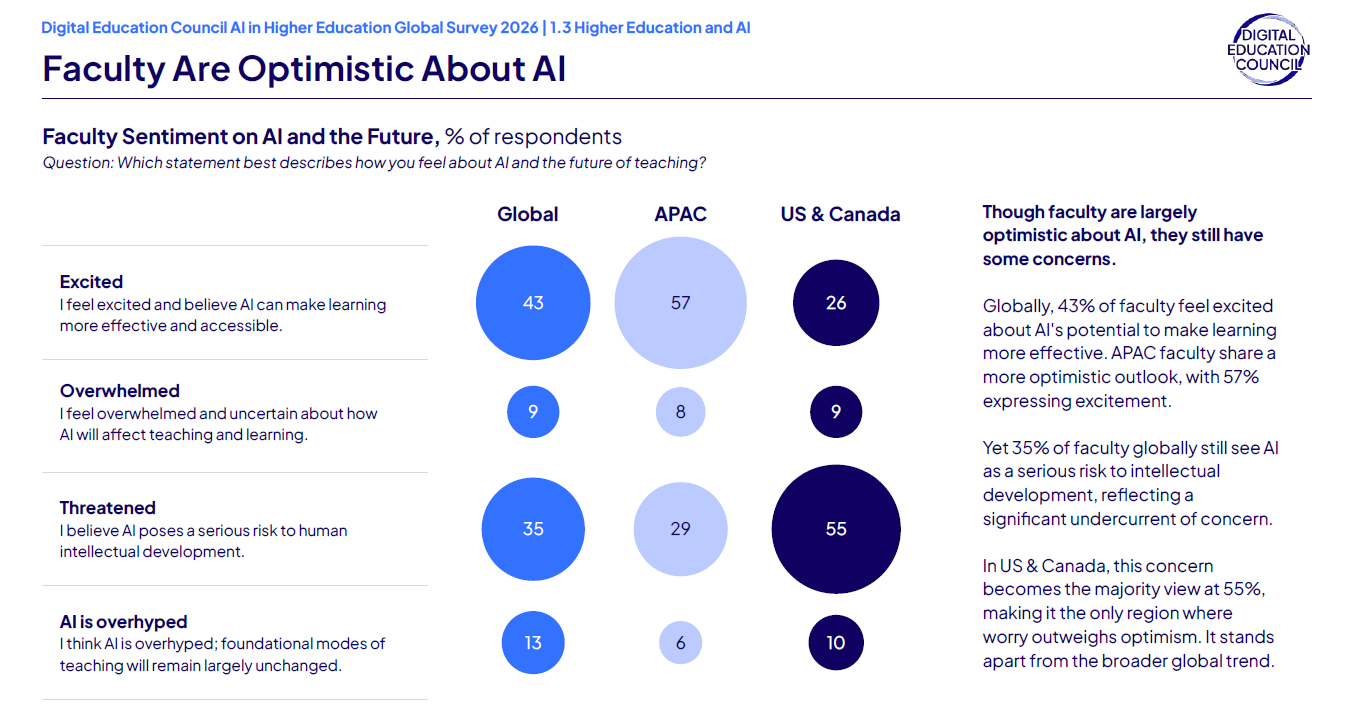
Worries about cognitive skills. In the U.S. and Canada, 55% of faculty say generative AI threatens human intellectual development, compared with 35% globally.
Pessimism about the future. In the U.S. and Canada, only 26% of faculty say they are excited about generative AI making learning more effective, compared with 43% globally and 57% in the Asia-Pacific region. The U.S. and Canada make up “the only region where worry outweighs optimism,” the report says.
Students also feel conflicted
Students’ views on generative AI in education look something like this: Our professors don’t know how to guide us on use of generative AI, and we don’t see the relevance of the work they are giving us or the curriculum as a whole. It isn’t preparing us for a workplace that uses generative AI, and we are seeing potential careers disappear because of AI. We have found ways to use AI to cut down on repetitive tasks and to work on more challenging topics, but we also see many of our classmates using generative AI to cheat, and that isn’t fair.
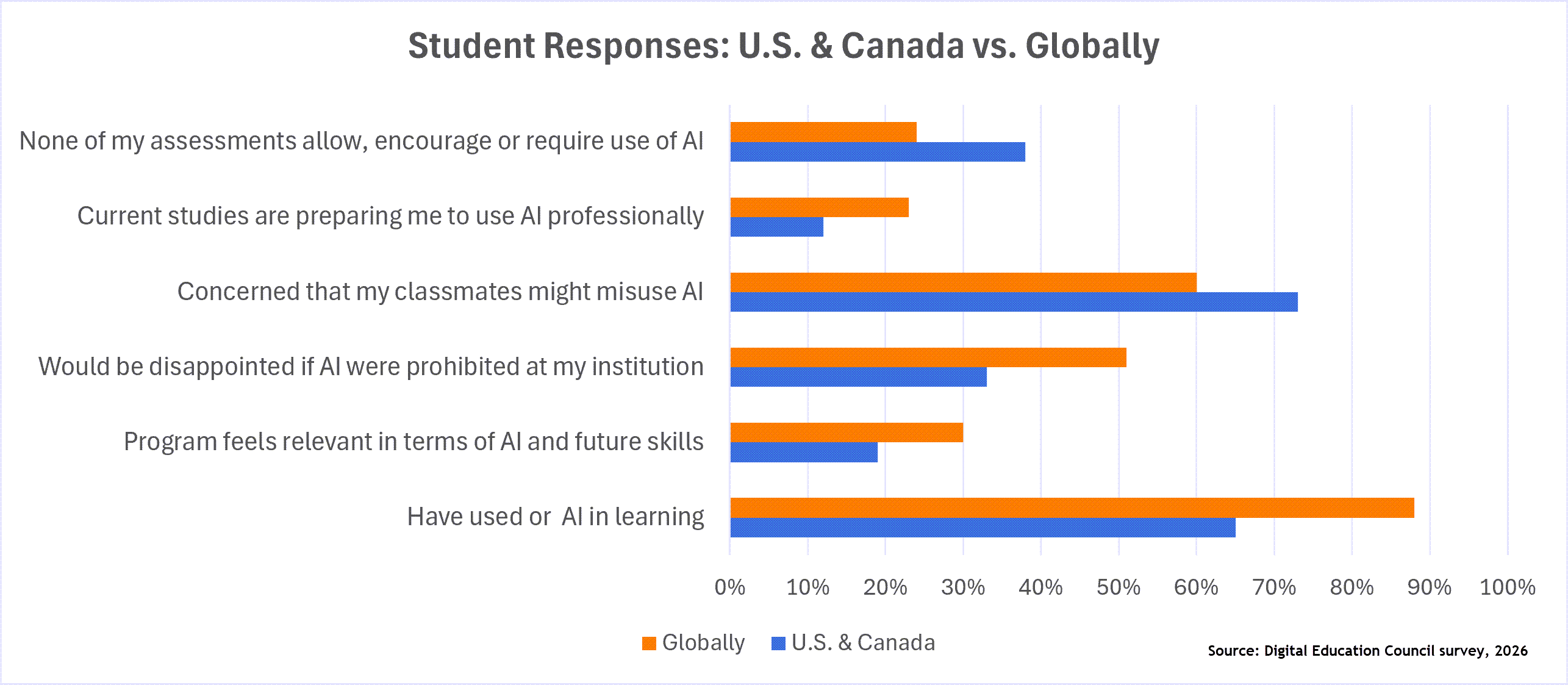
Globally, 88% of students say they use generative AI in their learning, but the breakdown by region is more complicated. In the U.S. and Canada, 65% of students say they use generative AI, compared with 92% in Latin America, 85% in Europe, the Middle East and Africa; and 78% in the Asia-Pacific region. Forty-two percent said AI was integrated into a few courses, and 43% said it wasn’t integrated into any courses.
Other results:
AI and thinking. Two-thirds of students say they worry that use of generative AI affects their thinking and their creativity; 21% said they had a hard time working without AI, and 19% said they were retaining less because of their AI use. Students are also unsure about the value of AI in learning: 43% said it was somewhat helpful and 32% said it was very helpful.
AI in courses. Fifty-seven percent of students say they lack clear guidance on AI use in assessments, and 72% say their coursework doesn’t help them gain the skills they will need in the workplace. In a webinar about the report, Bielik said universities were falling short in guiding students on AI use. Students hear that they should be prepared for a changing world of work, he said, but don't feel they are getting that in their classes.
AI bans. More than half of students (55%) in the U.S. and Canada say they would support a ban on use of generative AI at their institution, compared with 23% globally.
Instructor preparation. Globally, only 29% of students say their instructors are well-prepared to guide them on use of generative AI. In the U.S. and Canada, that is 17%.
Peer misuse of AI. Globally, 60% of students say they worry that misuse of generative AI will give their peers an unfair advantage, compared with 73% in the U.S. and Canada.
Cultural differences and lack of trust
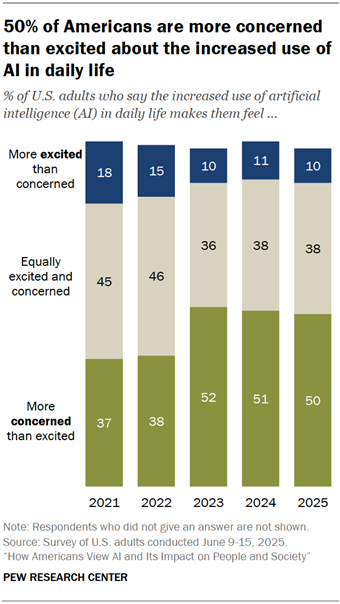
Faculty views on generative AI reflect broader American doubts. In a recent Pew poll, 50% of Americans said they were more concerned than excited about generative AI, 53% said it would decrease creativity, and 50% said it would harm relationships. In the U.S., home of the most widely used AI systems, only 31% of people trust the federal government to regulate generative AI responsibly. Canada and the United States also rank near the bottom in the percentage of people who say the benefits of generative AI outweigh the risks.
Lack of trust. Americans’ trust in institutions, including colleges and universities, has wavered and waned for several years, reaching what Pew says are historic lows. Social trust has also eroded during what David Brooks describes as four decades of hyperindividualism, with Americans losing “faith in one another, in our future and in our shared ideals.”
At the same time, a handful of large companies has pushed generative AI into the mainstream, with ChatGPT reaching 1 billion users faster than any other application of the past 30 years. A recent study argues that when people feel generative AI creating a sense of belonging with others, they also trust AI companies. In the U.S., Canada and other developed countries, though, less than a third of people trust businesses to use AI, and in a global poll, Americans had the least trust in their government to regulate AI.
Faculty-administrative divide. A separate survey from Microsoft suggests another divide: this between educators and administrators. College and university administrators were more likely than faculty to say that they know a lot about AI (61% vs. 51%) and use generative AI in their daily work (60% vs. 42%). They were also significantly more likely to say that their use of AI had increased substantially over the past year (64% vs. 34%) and that they were optimistic about the potential of AI (91% vs. 78%). Those differences suggest another potential area of conflict if leaders push adaptation to generative AI and faculty feel unprepared and unsupported.
Economic status. Researchers say that developed countries like the United States, Canada, and Australia have more doubts about AI than developing countries like India, Brazil, and Nigeria. People in China, Indonesia, and other Asian countries are overwhelmingly optimistic about AI. People in developing countries also have higher levels of AI literacy and have been more willing to learn to use AI effectively. Those who have learned to use AI are nearly twice as likely to trust AI as those who haven’t. A study by the University of Melbourne and KPMG International, explains the challenge this way: “Low levels of AI literacy may limit people’s ability to recognize the capabilities and applications of AI and thus fully realize benefits, and importantly, the ability to recognize the limitations of AI systems, critically evaluate their outputs, and guard against harm.”
Economic uncertainty. Nationwide, more than 150 colleges have closed or merged with other institutions since 2016 as enrollments have declined. Within institutions, low-enrollment programs have been eliminated or merged into other programs, and cuts in faculty and staff positions have been widespread. Compared with other developed nations, the United States has a meager social safety net. Losing a job means losing insurance coverage, and U.S. healthcare costs far exceed those in other countries. Because of that, “A.I. looks more like an ambush,” Paul Kedrosky writes in the New York Times, and “people are more worried about a socioeconomic trapdoor opening beneath their feet and eroding that stability.” On top of that, many faculty members view generative AI as something created by misappropriating intellectual property and devaluing their intellectual work, with large technology companies profiting at their expense.
Age. Countries with a younger median age express more optimism about AI. Those include Malaysia, India, Peru, Turkey, Mexico, South Africa, and Singapore. Age doesn’t always play a factor, though, as Korea and Thailand, two countries with older populations, have a more positive view of AI.
Lack of institutional support. At U.S. colleges and universities, decisions about generative AI have largely been ceded to faculty, who often see it as a threat to thinking, academic integrity, intellectual property, and their own jobs. Without a university strategy, they often feel helpless to respond to student misuse of generative AI. In the Digital Education Council survey, 24% of faculty in the U.S. and Canada said their institution had no direction on AI, compared with 11% globally. Faculty lack a clear sense of where AI fits into education (if at all), how it would help teaching and learning (if at all), and what it means for the future of education and society. They also lack time and support to rethink coursework, especially with demands for compliance with federal and state regulations; requirements from regents and accreditors; disengaged students; and fatigue from the pandemic. Generative AI feels like one more enormous demand on faculty time and energy.
Where is this leading?
We are approaching the fourth anniversary of the release of ChatGPT-3.5, the generative model that cannonballed into digital life and sent endless ripples through academia and business. After a poll from the Digital Education Council a year and a half ago, I suggested that colleges and universities faced a steep, rocky path in addressing generative AI. In the U.S. and Canada, that path has grown even steeper, with opinions about generative AI growing increasingly polarized. At the same time, more businesses are saying they expect college graduates to be able to work with generative AI in jobs.
Skeptical faculty are right about generative AI not fitting into the current academic structure. Rather, we must find ways to redesign courses so that AI use doesn’t matter but that students still gain the skills they need. We must also find ways to use AI to improve learning. Those are difficult challenges, especially amid polarized views, lack of time and support, and lack of clarity about the mission of higher education. Here’s how I suggest we move forward:
Develop a strategy. Each institution, school, and department should develop a plan on addressing generative AI. How do they envision AI fitting into the future of the institution or the discipline? How can they help students, faculty, and staff adapt? How can they learn from one another, sharing ideas and strategies?
Even before they do that, they must clarify the purpose of degrees, certificates, and courses. Higher education has never had a single purpose, but the views have multiplied and often feel disconnected: career training vs. life preparation; practical application vs. broader critical thinking; the “college experience” vs. skills for participation in a democracy; information delivery vs. development of durable skills. I put those in opposition, but they don’t have to be. We do need to better explain why education is structured as it is and how it can meet many goals.
Promote AI literacy. All students must have opportunities to learn about generative AI: how it works and where it fits into the broader AI landscape; how to use it effectively and ethically; how to navigate its many problematic aspects, including biases, effects on learning, intellectual property, and the environment; and how AI is affecting jobs and society. CTE has created an AI literacy course to help with that, and there are many other resources available. Until everyone has a base understanding of AI, though, we will struggle to find an appropriate strategy.
Provide AI fluency. Every student who wants to push deeper into generative AI should have that opportunity. Some KU programs are developing classes, minors and majors to help with that. Students who don’t want a major or a minor in AI, though, should have opportunities to learn and to practice their skills with generative AI so they feel confident when they start jobs.
Address the underlying problems. Student use of generative AI is a symptom of many systemic issues in higher education. Those include many students' lack of motivation and preparation for college; emphasis on grades, credit hours and seat time over learning; lack of clarity in the purpose of classes and curricula; overemphasis on information delivery in classes; and a devaluing of teaching in the rewards system. Any AI policies will be meaningless unless we address those structural problems.
That’s just a starting point, and the longer we delay, the more difficult it will be to adapt. That doesn’t mean AI everywhere all the time. Rather, it means accepting the presence of AI in jobs and society, and the obligation we have to our students to help them navigate AI use now and in the future. We can and should debate the ethics, the appropriate use, and the direction of AI, but we can’t act as if it doesn’t exist.
Posted on
by Doug Ward
Tagged artificial intelligence, future of higher education, student skills, teaching and technology
Tagged artificial intelligence, future of higher education, student skills, teaching and technology