Moving higher education from storied past to innovative future
Moving higher education from storied past to innovative future
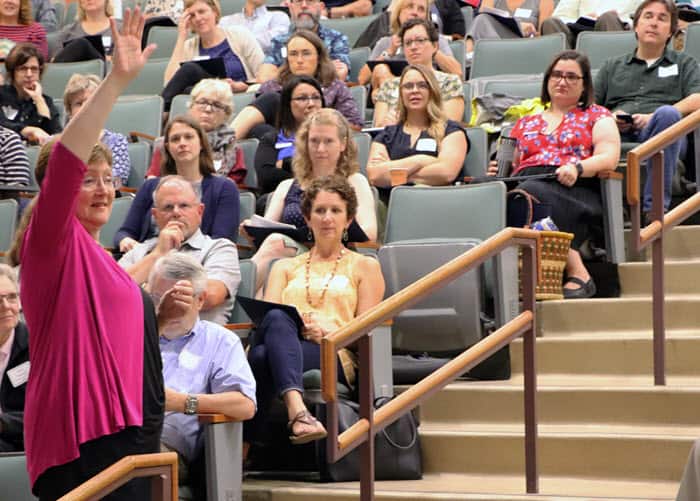
We know the story well. We helped write it, after all.
We know the story well. We helped write it, after all.
WASHINGTON – As colleges and universities prepare to encounter what has become known as a cliff in traditional student enrollment, they are looking for ways to reach out, branch out, and form partnerships that might once have been unthinkable.
I got a reminder this week of the value of collaboration.
In my 300-level hybrid class Infomania, I asked students to critique a hierarchical model of information and information processing explained by Gene Bellinger, Durval Castro and Anthony Mills.
Before you ban cellphones and laptops from your classroom, consider this: Students want to use those devices for learning and are looking to their instructors for guidance.
An organization called Reclaim Open Learning held its first symposium last week. The organization promotes innovation in higher education through the use of technology, online resources and open learning in unconventional ways.
Lecturing as an educational form emerged at a time of scarce information and oral culture. It’s a top-down method of conveying information that under the right circumstances can be quite effective, especially at motivating listeners.
Several faculty members and graduate students from KU attended this year’s conference of the International Society for the Scholarship of Teaching and Learning. I wasn’t able to go, though I did listen in on a few of the sessions remotely. I’ve collected tweets and videos into a Storify presentation that shows some of the thinking, conversations and approaches of the convention and the society.
A session from an education conference I listened in on last week reminded me of the parallels between teaching and editing.
That might seem strange, but bear with me.
Here’s my challenge for the week: Rearrange the furniture in your classroom.
Go ahead. Have students help you. Some may look at you quizzically, but they will soon understand.
If the room has tables, push them together and create collaborative clusters or arrange them in a U shape. If it has individual seats, get rid of the rows. Make it easier for students to see one another and to talk to one another. Make it easy for you to sit among them. Break down the hierarchies. Break down the barriers.
If you want to find a quick answer to a question, where do you go?
Google, most likely.
If you want to help students from half a dozen disciplines understand how the elements of linear algebra apply to them, where do you go?
Again, Google. But this time, think outside the search box.