Why you should think differently about your classroom
Here’s my challenge for the week: Rearrange the furniture in your classroom.
Go ahead. Have students help you. Some may look at you quizzically, but they will soon understand.
If the room has tables, push them together and create collaborative clusters or arrange them in a U shape. If it has individual seats, get rid of the rows. Make it easier for students to see one another and to talk to one another. Make it easy for you to sit among them. Break down the hierarchies. Break down the barriers.

Are you with me? If not, ask yourself why. Yes, I know that some classrooms – especially the large ones – have fixed seats. I can’t help you there. But for everyone else, changing the layout of a room to promote learning should be part of the routine.
I’m not suggesting that everyone teach in the same way. I am asking whether you are teaching in a way that gives students the best opportunity to learn. I’m also asking whether you are letting the room determine how you teach. If so, how much is room design getting in your way? And why aren’t you doing something about it?
Surprises from a classroom
I’ve always been quick to rearrange the furniture in classrooms, sometimes to the annoyance of colleagues. Last semester, though, I found out just how big a difference room design can make.
I taught two sections of a 300-level lass called Infomania. For one section, I was lucky enough to teach in The Commons, a fabulous space in Spooner Hall with high ceilings, lots of windows, hardwood floors, and tables and chairs on wheels. Emily Ryan, coordinator of The Commons, helped create clusters of tables. Students brought their laptops and tablets, and they had lots of room to spread out and create their own learning spaces.
The other section of the class was in the Dole Human Development Center. It was a traditional classroom with rows of individual desks. It was crowded, stuffy and oppressive. Most of the students came into the room to sit and endure, not to learn. I had the students move their desks together, but that didn’t help much. The small room allowed little maneuverability, and the individual seats created a sense of isolation.
So I tried something. I talked with Emily and arranged for the class to meet three times in Spooner Hall. The change in student behavior was almost instantaneous. Those who had sat passively became engaged. Collaboration thrived. Conversations flowed. Ideas spilled out.
The dramatic change the room brought about surprised me, but it seemed to surprise the students even more. We talked about how a room configuration can lead to passivity, and how students have been trained to come to class, find a seat as far back as possible, and wait for someone at the front of the room to start talking to them – or at them.
Rethinking teaching as well as room design
The room isn’t the only guilty party in this pervasive passivity. Pedagogy plays a huge role. For far too long, instruction has focused on a one-way transmission of information. Teachers speak. Students listen and take notes. Change classes. Repeat. And yet room construction is an accomplice in all this, one that sets the scene and often sets the tone of a class.
Once my students realized this last semester, they repeatedly asked to move from the crowded classroom in Dole. I wasn’t able to find a substitute room at midsemester, so I began meeting with groups of students in Watson, Anschutz and Spencer libraries, in the Union and at the Underground instead. We still met occasionally for full-class discussion in the assigned classroom, but no more than we had to. The students and I recognized that the classroom was impeding their learning. It was best to stay away.
So back to my challenge: Rearrange the furniture in your classroom this week. It may not transform your class, but it will change the atmosphere. If that doesn’t work, try meeting somewhere else. Break the routine and eliminate the built-in passivity of traditional rows. It can make an enormous difference in learning.
Doug Ward is an associate professor of journalism and a fellow at the Center for Teaching Excellence. You can follow him on Twitter @kuediting.
We need to do a better job of explaining our teaching
A session from an education conference I listened in on last week reminded me of the parallels between teaching and editing.
That might seem strange, but bear with me.
I used to commute on Amtrak between Philadelphia and New York City, where I worked at The New York Times. One afternoon, I sat next to a chatty woman who wanted to know all about my job as an editor. As the train sped through central New Jersey, I explained how editors scrutinize the work of others, raising questions, fixing errors, working out the kinks in articles, pushing reporters to provide better context and better phrasing, writing headlines, and completing innumerable other tasks that lead to the publication of a newspaper.
As the train pulled into Penn Station, she thanked me and said, “I’ll watch for your byline.” I didn’t have the heart to tell her that she wouldn’t find one. Editors work behind the scenes. They don’t get bylines.
That’s what I started to think about during the remote session from the International Society for the Scholarship of Teaching and Learning. Those of us who teach know the myriad components that go into our jobs. Most people don’t realize that, though. They equate teaching with standing in front of a room just as they equate journalism with writing articles that get bylines.
Of course, ISSOTL, as the organization is known, has worked for the last decade to not only open up the teaching process, but to promote the importance of a scholarly approach to reflective teaching in higher education. Dan Bernstein, the director of CTE, has been at the forefront of using teaching portfolios to do that.
As participants at the conference made clear, though, we still have a long way to go. At research universities, especially, scholarly reflection on teaching has yet to achieve a meaningful place in the promotion and tenure process. Some professors see teaching as a necessary evil they must endure so they can concentrate on their research. Many faculty members who do value teaching find it difficult to open their work to scrutiny. Without a doubt, teaching is a far more personal activity than research, and the setbacks and failures feel far more personal.
Christina Hendricks, a senior instructor in philosophy at the University of British Columbia, raised that point in her session at ISSOTL. “Sometimes people don’t want to open up their teaching to discussion or peer evaluation,” she said. “It’s as if it’s OK to open up your research to peer review but not your teaching.”
She had been keeping a journal to reflect on teaching and learning, she said, and at one point thought, ” ‘Why not do it in a way that other people can see?’ ” The result was a blog called You’re the Teacher, in which she reflects on her teaching of undergraduates, and writes about issues related to the scholarship of teaching and learning, among other things.
We’re hoping to do similar things with Bloom’s Sixth. We see enormous value in discussing our successes and failures in the classroom, sharing ideas about teaching and learning, raising the profile of high-quality teaching in higher education, and approaching teaching in the same reflective, meaningful way we do scholarship.
Another ISSOTL speaker, whose name was lost in the remote connection last week, offered a useful challenge, saying, “We don’t talk enough about the exciting things we do. We need to turn the narrative of teaching into a narrative of growth.”
Without a doubt, we need to do a better job of explaining what we do and of encouraging colleagues to join us in a journey of scholarly reflection and a deeper understanding of what helps our students learn.
As I discovered in trying to explain editing, though, true understanding will require far more than a single conversation.
Doug Ward is an associate professor of journalism and a fellow at the Center for Teaching Excellence. You can follow him on Twitter @kuediting.
Insights on teaching and learning from #issotl13
Several faculty members and graduate students from KU attended this year’s conference of the International Society for the Scholarship of Teaching and Learning. I wasn’t able to go, though I did listen in on a few of the sessions remotely. I’ve collected tweets and videos into a Storify presentation that shows some of the thinking, conversations and approaches of the convention and the society.
Teaching Matters focuses on redesign of large lecture classes
Lecturing as an educational form emerged at a time of scarce information and oral culture. It’s a top-down method of conveying information that under the right circumstances can be quite effective, especially at motivating listeners.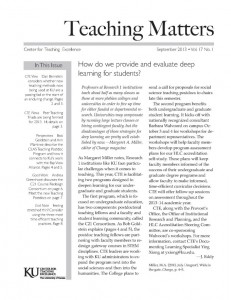
For many students, though, the lecture can seem like more of an endurance test than a learning experience. In a world of abundant information, lecturing is usually not the best method to help students learn. Many faculty members have long suspected as much, and research has been bearing that out.
The latest edition of Teaching Matters from the Center for Teaching Excellence looks at a movement at KU to shift away from traditional lecture. Among the articles you’ll find:
- Judy Eddy on KU’s efforts to provide deeper learning for students
- Dan Bernstein on the challenges of changing the culture of teaching
- Bob Goldstein and Ann Martinez on a new program that is using post-doctoral researchers to help faculty members transform gateway courses
- Andrea Greenhoot on a new community of faculty members, graduate assistants and postdocs working across disciplines to improve KU courses
Look for Teaching Matters in your campus mailbox. You can also find it online at the CTE website.
Doug Ward is an associate professor of journalism and a fellow at the Center for Teaching Excellence. You can follow him on Twitter @kuediting.
Thought-provoking suggestions from a conference on open learning
An organization called Reclaim Open Learning held its first symposium last week. The organization promotes innovation in higher education through the use of technology, online resources and open learning in unconventional ways.
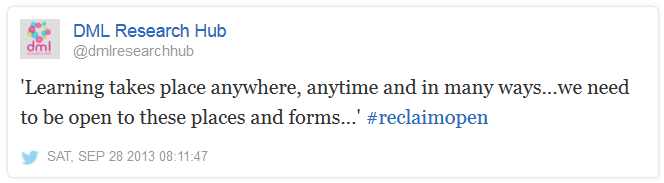
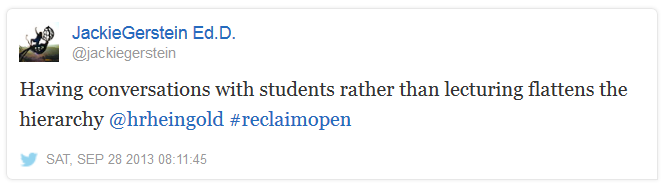
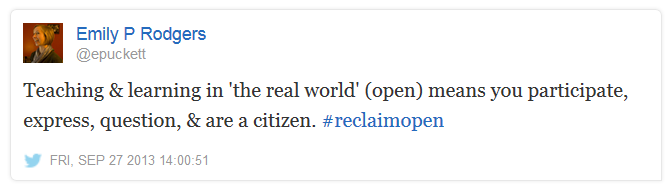
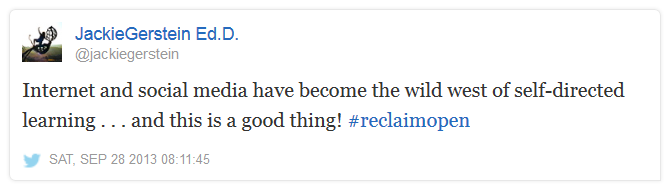
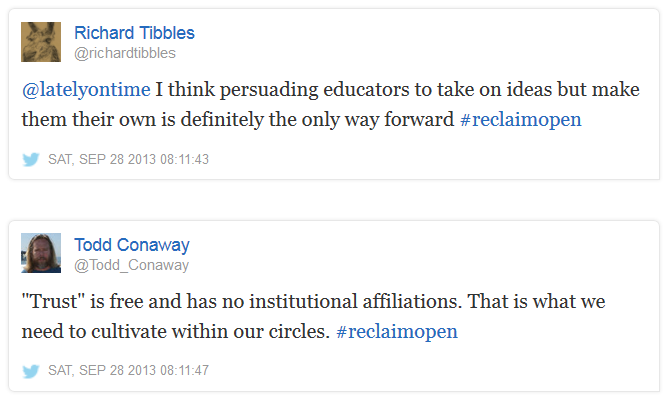
The approach and goals of Reclaim Open Learning aren’t for everyone, though I embrace most of the same principles in my course Infomania. I found the comments emerging from the symposium thought-provoking and useful. I created a Storify compilation of some of the tweets on learning, innovation, promoting change, and the role of education in a digital age. You’ll find that compilation on another site, Teaching with Technology. I’ve provided a taste of some of those tweets here.
Doug Ward is an associate professor of journalism and a fellow at the Center for Teaching Excellence. You can follow him on Twitter @kuediting.
What we can learn from a new study on students and technology
Before you ban cellphones and laptops from your classroom, consider this: Students want to use those devices for learning and are looking to their instructors for guidance.
That’s one of the takeaway points of the latest study by the Educause Center for Analysis and Research on students and information technology. The center, known as ECAR, has conducted an annual survey of undergraduates since 2004, accumulating a wealth of data on students and technology. This year’s survey drew 113,000 responses from students at 251 colleges and universities.
Most of the key findings in this year’s study mesh with my own experiences with students. Among them:

Students value the social component of education. More than 40 percent of students have taken an online class, but most still prefer in-person classes that give them the opportunity to interact with instructors and fellow students. Older students who have jobs report a higher preference for online classes.
Students like classes that blend online and in-person components. They say that they not only prefer classes with a flipped, hybrid or blended approach but that they learn more in those classes.
Students want instructors to integrate technology into learning. Nearly three-fourths of respondents would like to have online access to recorded lectures, and slightly smaller percentages would like to see more use of learning management systems like Blackboard. They would also like to see more use of online collaboration tools.
Students’ ownership of technology is growing. Ninety percent of students own at least two Internet-capable devices, and 60 percent own three or more. This includes laptop computers (90 percent of students own one), smartphones (75 percent) and tablets or e-readers (48 percent). Students who own more technology are also more likely to see its potential for learning.
One of the most important points of the survey, I think, is that students want their instructors’ help in understanding how to use new software and new technology, and to use digital tools for learning. Not for texting. Not for watching YouTube videos. For learning.
Saying and doing don’t always go together, of course, and as the study points out, this is an ambiguous and often contentious issue. Students want to learn with technology, but most prefer to separate their social and academic lives. They value their privacy, and they express hesitation about software that tracks their academic work and gives them recommendations for course offerings. They also understand the distractions that technology can bring to the classroom, and many prefer to keep their phones stowed away. Others chafe at bans on technology in class, something that large percentages of instructors do, the survey says.
Despite the distractions that technology can bring, it is an integral part of students’ lives. It’s also an integral part of the learning equation. For instance, 60 percent or more of students say that technology helps them feel more connected to their college or university, and to their instructors. They also see it as important not only for their academic success but for their success in the workplace.
There’s no one size fits all approach to technology in the classroom, but it’s clear that we need to do a better job of harnessing the power of technology for what instructors and students say they want: more opportunities for learning.
Doug Ward is an associate professor of journalism and a fellow at the Center for Teaching Excellence. You can follow him on Twitter @kuediting.
A classroom lesson in collaborative learning
I got a reminder this week of the value of collaboration.
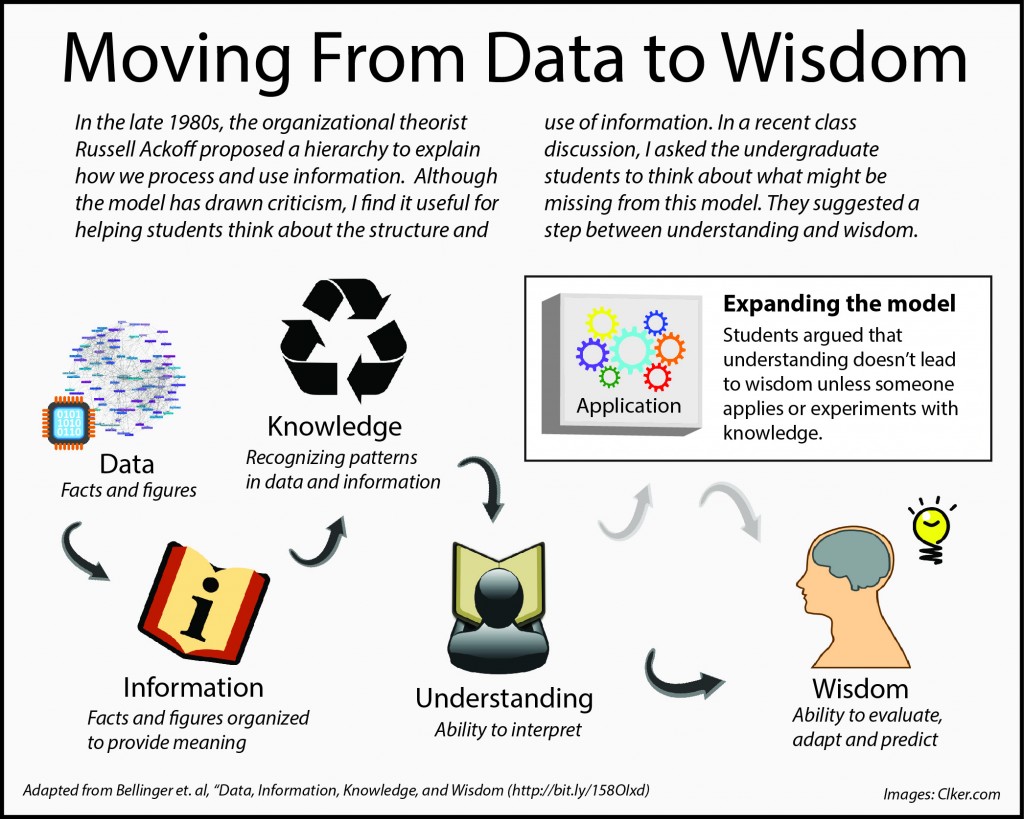
In my 300-level hybrid class Infomania, I asked students to critique a hierarchical model of information and information processing explained by Gene Bellinger, Durval Castro and Anthony Mills.
The model, originally proposed by the organizational theorist Russell Ackoff, is often portrayed as a pyramid with data at the bottom and wisdom at the top. The model has come under criticism for being too simplistic, and yet I find it useful in helping students consider the complexities of information.

In Infomania, students work in one of five groups online and in person. We generally have one class period each week devoted to discussion and another devoted to project work.
At the start of discussion this week, I gave each group a different question related to the readings and then had students explain what their groups talked about and what conclusions they had reached.
I was reluctant to assign the question about information hierarchy, fearing that it would be too difficult. I was curious, though, so I asked students to consider this: What, if anything, is missing from Ackoff’s hierarchy of information?
When it was their turn, the students who had that question didn’t hesitate. They said the model needed a better explanation of how one moves from understanding to wisdom, the top two layers of the hierarchy. To truly gain wisdom, they said, you have to apply your understanding.
I was blown away. They had altered an established theory of information, making it not only more meaningful but more useful.
I asked another group to explain the components and importance of digital literacy, the focus of an article by Howard Rheingold. One of those components is collaboration. At one point in the discussion, I asked: What’s the value of collaboration?
One student replied: “Two heads are better than one.”
True, I said. But those two have to listen to each other, engage each other and share meaningful ideas.
That’s the real value of collaboration.
Doug Ward is an associate professor of journalism and a fellow at the Center for Teaching Excellence. You can follow him on Twitter @kuediting.

Education Matters: Active learning, Educause, and student skill levels
Notes by hand or with laptops? Sorry, wrong question.
Cathy Davidson raises exactly the right question in the debate about whether students should take notes by hand or with laptops in class. The real issue, Davidson writes, is that instructors should be working to avoid lecture and instead engage students in active learning. Even in a large lecture hall, instructors can use active-learning activities that help students learn far more than they would with lecture. Davidson’s suggestion doesn’t involve digital technology. Rather, she says, a simple notecard will do.
Tom Whitby, in Edutopia, reinforces Davidson’s argument by explaining the importance of collaboration in modern pedagogy.
If textbooks are dead, are universities next?
Educause, an orgranization that focuses on information technology in higher education, held its annual conference this week in Orlando, Fla. Most of the discussions were geared more toward IT than educators, but a few interesting nuggets caught my attention:
 The president of McGraw-Hill Higher Education declared that textbooks were dead and that adaptive learning was the future, EdTech magazine reported, and the Harvard professor Clay Christensen said that online learning was diminishing the importance of traditional universities.
- Blackboard announced a new cloud version of its learning management system and said that it had struck a deal with Lynda.com to provide easy access to Lynda’s online courses in Blackboard Learn, EducationDive reported.
- Reporting on their use of predictive modeling, representatives of Sacramento State University said that students who enrolled in summer classes after the freshman year of college, took freshman seminars, and took a full load of classes during their freshman year were more likely to graduate than those who didn’t.
Helping students take control of class discussions
In an article in Hybrid Pedagogy, Chris Friend shares some techniques for letting class conversations evolve organically. He writes, “A class discussion where the teacher pre-determines the outcome is just a lecture in disguise, dressed up to feel student-centered while still being instructor-directed.”
Making sure all group members pull their weight
Li-Shih Huang offers tips on making sure all members of a project group share in the workload. Those tips include designing projects so that students complete them in phases, allowing students to choose project topics that match their own interests, and helping students become better problem-solvers. You’ll find the full post at Faculty Focus.
Number of stay-at-home college students hits 20-year high
National Journal reports that the number of college students living at home has reached a 20-year high. Tuition increases and “an economy that still feels like a recession to many families” have played a role, National Journal writes, saying that the combination “may be turning more students into pragmatists.” That shift can make diversifying the student body more challenging.
What to do when a class has a wide range of skills
In an article on differentiated learning, Christina Yu offers suggestions on helping students with wide ranges of skills in the same class. She suggests avoiding a technique that is often recommended: having students who understand course material help those who don’t. I wish she had explored that area more. That approach can certainly help in some scenarios. Yu doesn’t dismiss it outright; rather, she includes it in a list of “what differentiated instruction is not.”
A trend worth watching
eSchool News reports that tablet use is growing increasingly common in grades 4 through 12. School tablet use has reached 66 percent in grades 4-5, 58 percent in grades 6-8, and 42 percent in grades 9-12, the publication reports. Moreover, 81 percent of students say that tablets help personalize learning. These are students who will be in college in the coming years.