Education Matters: Grading participation, defining rigor, valuing a degree
How can we grade participation more effectively?
Maryellen Weimer argues that the way we usually grade participation in our classes doesn’t work. That is, many students still don’t join the conversations for fear of looking dumb. The typical grading approach also rewards quantity over quality. In an article in Faculty Focus, she writes about a colleague’s solution to this: using “extra-credit engagement tickets” students earn by completing assignments on time, joining online discussions, and submitting questions electronically. I agree with the logic, but the solution seems more complicated than I’m willing to attempt. This is definitely something that deserves more attention from most faculty members, though.
What does ‘rigor’ in a course mean?
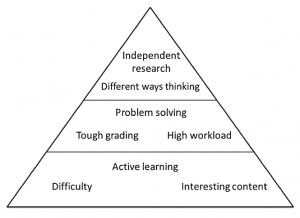
Students tend to equate a course’s rigor with workload rather than higher-order thinking, according to a study in the latest issue of Innovative Higher Education. That is, if a course required students to read or write more than they were used to, they generally considered it rigorous. The same held true if a student thought the professor’s grading standards were higher or if the student had little or no previous experience with the course content. This differs from faculty members’ idea of rigor, which the authors described as “learning meaningful content with higher-order thinking at the appropriate level of expectation within a given context.” The authors say that students and faculty need to understand these divergent views so that colleges and universities can better address the importance of academic standards. The study is called “Developing a Student Conception of Academic Rigor.”
Study questions value of degrees from for-profit online institutions
Research by the National Bureau of Economic Research strongly suggests that employers value degrees from public institutions over those from for-profit online institutions. The authors of a white paper posted on the bureau’s website found that candidates with bachelor’s degrees from for-profit online institutions were 20 percent less likely to receive a request for an interview or for additional information from employers than those with degrees from public institutions. (A 2012 employer survey conducted by The Chronicle of Higher Education found similar perceptions.) They say that given the high costs, degrees from those for-profit institutions “do not appear to be a sound investment.”
Briefly …
Meris Stansbury of eCampus News writes about the steps involved in a competency-based education program, and about the fluid definition of those types of programs. … An anonymous graduate student, writing in The Guardian, argues that colleges and universities need to more transparent about the time commitments of graduate teaching assistants. “Teaching is often regarded as something of an afterthought to doctoral completion, something fobbed off on those considered just competent enough,” the writer says.
Education Matters: Phone book teaching, dropout rates, tech tools
Why a phone book isn’t a good learning tool
Daniel J. Klionsky of the Life Sciences Institute at the University of Michigan asks why so many instructors or programs continue to teach facts that students don’t need to know. In an article in Faculty Focus, he uses the telephone book as an example. No one needs to memorize all the numbers in a phone book. The idea is absurd. And yet, many instructors in science courses insist that students memorize facts they can easily look up, just as they would with a phone book. To help weed out the essential from the nonessential, he says that instructors should approach their courses with these questions:
- How much of the information in our courses do the students really need to know?
- How much time do we devote to making sure students know when they need a fact and how to look it up?
- Do our students know what to do with the facts once they find them?
Dropout rates hit record lows
Pew Research reports that the high school dropout rates have reached a record low, 7 percent, continuing a decline that started in the mid-1990s. The dropout rate among Hispanics has declined by more than half since 1993, and the rate among blacks has been cut in half. Even with the declines, though, the number of high school dropouts is more than 2.2 million.
Those gaps that speak volumes
Matthew E. May writes about the creative power of empty space in attracting attention and intriguing audiences. His piece in the Harvard Business Review is aimed at marketers, but it applies equally as well to educators.
Digital technology for education
Jane Hart has released her annual list of the top 100 tools for learning. The top of the list offers no surprises – Twitter, Google Drive, YouTube, PowerPoint – but the latter part is a good place to look for new tools you might try. It includes some that I’ve found useful, including Explain Everything and Powtoon.
The Chronicle of Higher Education reports on an app under development at Dartmouth that helps measure students’ mental health.
Education Matters: College efficiency, skills vs. broad thinking, and adaptive learning
A focus on efficiency, for learning’s sake
The Evolllution began a series on operational efficiency at colleges and universities with an interview with Cathy Sandeen, vice president for educational attainment and efficiency at the American Council on Education. Sandeen lays out the right goals for cost efficiency, saying the process should aim at ways to help students learn and earn their degrees. “We need to work together to figure out how we can change and do things differently,” Sandeen says. “It’s not saying we’re doing things wrong in the past; it’s just how we can do things better in the future.”
During October, the Evolllution plans to tackle these questions:
- What impact does operational efficiency have on institutional growth and competitiveness?
- How can postsecondary leaders effectively communicate the value of efficiency-related changes to institution-wide stakeholders?
- Do students notice when institutions are efficient?
- How can institutions leverage technology tools to become more efficient?
Job skills vs. liberal education
Emmanuel Felton of The Hechinger Report writes about how City Colleges of Chicago remade themselves by aligning courses with the skills that were most in demand in the region. The change has helped City Colleges, a system of seven community colleges, improve abysmal graduation rates, at least somewhat. Felton interviewed several business leaders who espoused the benefits of tying education to skills that industry needs. One executive said higher education needed to take the same approach. That might serve some students and it would certainly serve industry in the short term. In the long term, though, we need a wide range of people who possess the critical-thinking and adaptive skills provided by a liberal education.
 Keep an eye out for student mental health issues
Claire Shaw at The Guardian urges instructors to pay attention to students’ mental and physical state. She provides a list of warning signs that may indicate that students need assistance. She also offers several suggestions for instructors to help prepare themselves for struggling students.
A worldwide shortage of teachers
A new UNESCO report says that 93 countries face a chronic shortage of teachers and that many of them are recruiting people who lack any training in education.
An adaptive system that helps personalize learning
Stephen Downes of the National Research Council of Canada writes about beta testing of an adaptive learning system that combines customized materials from dozens of sources with data from learning, social environments and work environments. He calls this a “learning and performance support system.” Despite the stuffy name, it sounds fascinating.
Way cool: A tool for creating animated whiteboard videos
I’ve always been fascinated by animated whiteboard videos that show drawings being created in fast motion right before my eyes. I just came across a tool called VideoScribe that will help create those videos – for a price, of course. The software costs $198 a year. There’s a seven-day free trial, though. I’m going to have to give it a try. I’ll share my results.
Some radical, and not so radical, ideas for improving education
There’s no shortage of ideas for remaking higher education.
Consider a few recent ones:
- Identifying educational niches and providing more flexibility in course structure for students.
- Replacing classes with modules.
- Replacing degrees with badges.
- Doing away with classrooms and giving students their own learning space instead.
Margaret Rhodes at Wired is among the latest to report on ideas for remaking an antiquated educational format that rewards students for taking notes, memorizing facts, and then checking boxes on tests.
“Students don’t need information,” Rhodes writes. “They need to learn how to process and use it.”
Bravo!
Rhodes offers four ways to help higher education become more creative, based on ideas from the Stanford School of Design:
- Revamp the timeframe. Substitute the four-year degree for a six-year program that allows students to move in an out as their needs change.
- Eliminate class designations. Rather than designating students as freshmen, sophomores, juniors or seniors, let them range across the curriculum, learning and then applying and then learning something new.
- Ditch the transcript. Rather than focusing on GPAs, focus on skill building and portfolio development.
- Forget majors. Rather, have students declare goals or missions and let them take classes that help them meet those goals.
Cathy Davidson of City University of New York immediately added two other ideas to the list: eliminate tuition, and provide better pay for high-quality instructors.
Davidson is spot-on in her argument that radical changes will have little effect unless we’re willing to change the underlying problems. That is, we say we want high-quality education but still fail to provide the incentives and rewards that would make that happen.
Leonard Cassuto, a professor of English at Forham University, explains perhaps the central difficulty of elevating teaching in the research-driven culture of higher education. “It’s not that teaching doesn’t matter,” Cassuto writes, “but even many community colleges are looking for publication these days. It’s the only credential that crosses institutional boundaries, so it’s the easiest one for institutions to brag on.”
Cassuto is right, but even in higher education’s research-driven culture, we brush aside teaching as impossible to measure. So we send research packets out for external review when a professor goes up for tenure or promotion, but to evaluate teaching, we generally resort to student evaluations and observations of a single class. We shrug our shoulders and move on.
We can change that. The Provost’s Task Force on Course Redesign, of which I was a member, offered several solutions to improving teaching at KU. The solutions apply to every university, though. They aren’t particularly radical, and there’s nothing as eye-popping as the ones from the Stanford School of Design. Rather, the ideas are intended to help change the culture of teaching and the systemic problems that hold good teachers back. They include these:
- Create community. We need to identify faculty who want to improve or change their courses and provide opportunities for them to network with similar-minded instructors to share ideas that will lead to additional change.
- Encourage collaboration. This means within departments but also among departments and universities to share ideas and approaches to improving education. It also applies to faculty members who teach different sections of the same course.
- Provide support. We need to expand programs that provide support for faculty members interested in changing their courses. In our case, that includes the C21 Consortium and the teaching fellows program, both of which help faculty members and departments improve active learning.
- Recognize and reward effective teaching. Until we truly reward innovative, high-quality teaching in the same way we reward innovative, high-quality research, we have little hope of wide-scale change.
- Increase funds for remaking classrooms. Classrooms alone won’t change anything, but as I’ve written previously, classroom design can indeed improve student engagement and motivation.
- Make better use of digital technology for learning. Good teaching starts with sound pedagogy, but digital technology provides the means for reaching students in new ways, making courses more engaging, and time-shifting assignments so we can make better use of class time to address areas where students struggle.
Whether radical or not-so radical, the ideas for improving higher education offer no magic powers. Rather, they provide blueprints we can follow and frameworks on which we can build.
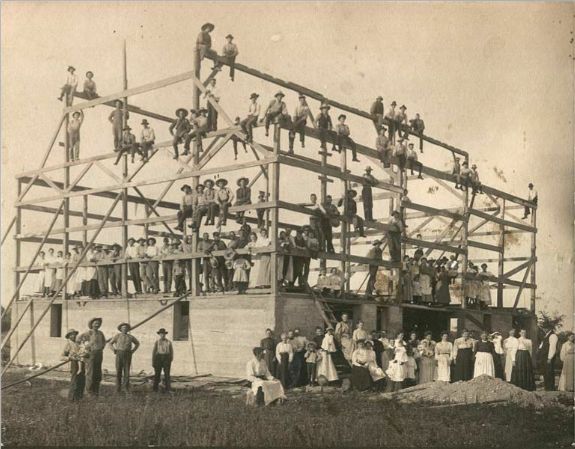
Think of an old-fashioned barn-raising, which provides a lens for looking at many aspects of education. By joining our forces and applying our expertise, we can create something that none of us could accomplish individually. And yet, to effect change we need individuals to step up and join the community.
Doug Ward is an associate professor of journalism and the associate director of the Center for Teaching Excellence. You can follow him on Twitter @kuediting.
Education Matters: College costs and trends, and a look into the future
That pricey fifth (or sixth) year of college
Jon Marcus of the Hechinger Report writes about the overlooked cost of a fifth or sixth year in calculating the cost of a college education. Ninety percent of freshmen begin college thinking they will graduate in four years, though less than half actually do. … Also, in a disturbing trend, Hechinger reports that the number of homeless students in U.S. public schools has grown 58 percent since 2007-08.
Some trends worth watching
In a report released last week, the consulting firm Michael Cohen Group identified several digital trends in education. The report, which was created in late spring, provides no real surprises yet highlights some of the issues that educators everywhere should pay attention to, including social media, open educational resources, massive open online courses, blended learning, flipped courses, gamification, integration of coding into courses, digital simulations, bring-your-own-device programs, assessment, big data, and adaptive learning.
The biggest challenge in educational technology? Managing change.

In its most recent research report, the Center for Digital Education says that technology itself “is never the biggest hurdle” in a changing educational environment. The biggest challenge is managing the changes brought on by technology, including integration into curricula, development of effective personalized learning, and effective training for teachers and staff members who use technology. Above all, the center said, institutions need to help instructors, students and staff member “think about how technology can fundamentally turn old pedagogy on its head.”
A startling statistic from the report: Singapore spends $21,200 per student on education annually, compared with $2,500 in the United States.
The university of the future
U.S. News & World Report recently looked at the challenges that colleges and universities face amid changing demographics, rising costs, a hypercompetitive admissions process, and a growing adoption of online courses, among other things. As part of the report, called College of Tomorrow, U.S. News asked six university leaders to offer their thoughts on the future. They talked about the need for improving transparency, leveraging research, and continuing to challenge students with new opportunities.
The most pessimistic, or perhaps realistic, was Robert Mendenhall, president of Western Governors University. Mendenhall said higher education in the future would probably look a lot like it does today, given the resistance to change on college campuses. He sees a need for change, pointing to areas like accountability and the growth in nontraditional students, and says that colleges that don’t may not survive.
Shirley Ann Jackson, president of Rensselaer Polytechnic, touched on areas I see as among the most important for the future. She wrote, “Students need to acquire new skills for this digitally interconnected environment, including the ability to ‘translate’ between and among disciplines and sectors. They must learn to operate effectively and ethically in virtual communities, immersive environments, and in blended worlds.”
How millennial are you?
Finally, educators need to do a better job of understanding all their students, including Generation Z, but Pew Research republished a four-year-old but still relevant quiz last week about understanding millennials. It’s worth a look.
Doug Ward is an associate professor of journalism and the associate director of the Center for Teaching Excellence. You can follow him on Twitter @kuediting.
Why assess student work? For yourself, of course.
At a meeting of the CTE faculty ambassadors last week, Felix Meschke brought up a challenge almost every instructor faces.
Meschke, an assistant professor of finance, explained that he had invited industry professionals to visit his class last semester and was struck by how engaged students were. They asked good questions, soaked up advice from the professionals, and displayed an affinity for sharing ideas with speakers from outside the university.
The interaction was marvelous to watch, Meschke asked, but how could he assess it? He could ask a question on an exam, he said, but that didn’t seem right. The content of the discussions wasn’t as important as the discussions themselves and the opportunities those discussions brought to students.
In a sense, Meschke had answered his own question: His observations were a form of assessment. I suggested that he log those observations so he could provide documentation if he needed it. No, that wouldn’t provide a numerical assessment, but it would provide the kind of assessment he needed to make decisions on whether to do something similar in the future.

All too often we think of assessment as something we do for someone else: for administrators, for accreditors, for legislators. Assessment is really something we need to do for ourselves, though. Thinking of it that way led to an epiphany for me a few years ago. Like so many educators, I approached assessment with a sense of dread. It was one more thing I didn’t have time for.
When I started thinking of assessment as something that helped me, though, it didn’t seem nearly so onerous. I want to know how students are doing in my classes so I can adapt and help them learn better. I want to know whether to invite back guest speakers. I want to know whether to repeat an assignment or project. I want to know what students report about their own learning. All of those things are natural parts of the teaching process.
That sort of thinking also helped me to realize that assessment doesn’t have to be quantitative. Assessments like quiz and exam grades can indeed point to strengths and weaknesses. If a large majority of students fails an exam, we have to ask why. Was there a problem in the way students learned a particular concept? A flaw in the wording of the exam? A lack of studying by students?
I rarely give exams, though. Rather, I use things like projects, journals and participation.
I use rubrics to grade the projects and journals, but the numbers don’t tell me nearly as much as the substance of the work. Only through a qualitative assessment do I get a sense of what students gained, what they didn’t gain, and what I need to rethink in future semesters.
In the class Meschke described, students applied their learning through active participation. Trying to put a numerical value on that would in some ways cheapen the engagement the students showed and the opportunities they gained in interacting with professionals. Observing those interactions provided excellent feedback to Meschke, though, and by writing a brief summary of his those observations, he could provide documentation for others.
The message was clear: Do it again next semester.
And when it comes to assessment, the message is clear, as well: Do it for yourself.
Additional resources
Portfolio Assessment: An Alternative to Traditional Performance Evaluation Methods in the Area Studies Programs, by Mariya Omelicheva
Assessment Resources for departments and programs at KU
Combining Live Performance and Traditional Assessments to Document Learning, by the School of Pharmacy
Doug Ward is an associate professor of journalism and the associate director of the Center for Teaching Excellence. You can follow him on Twitter @kuediting.
Humanity pays off in the classroom and beyond
Good teaching often starts with a simple greeting to students.
A simple hello will work. A smile helps. So does body language that signals a willingness to work with students. That recognition — both inside and outside the classroom — can go a long way toward engaging students and setting the tone for an assignment, a class or even a college career.
We can’t forget that. Stellar lesson plans, carefully chosen readings and incisive questions mean little if students aren’t engaged. That doesn’t mean that every instructor needs a cult of personality. Not at all. It simply means that an instructor needs to show human elements that students can relate to. They have to connect in some way.

At a discussion at CTE in the spring, a group of freshmen explained just how important that is. During their first semester, those freshmen were trying to find their place on campus: Where did they belong? Did they belong? How would they know?
One drove home the point this way: A few weeks into her first semester, she was still feeling unsure about herself and about KU. When one of her professors smiled and greeted her in the hallway one day, though, she felt validated. Her professor recognized her. He knew who she was. He said hello. That simple acknowledgment made her feel that she had a place on campus.
Charlie Blaich and Kathy Wise made a similar point in their opening plenary at the annual Teaching Summit last month.
Good pedagogy is important, Blaich said, but students need professors who make connections with them. They notice instructors who experiment with teaching and pay attention to students. They seek them out, and they learn from them.
“Being human and being present for them is a really important thing,” Blaich said.
A Gallup-Purdue Index Report released earlier this year further reinforced that idea. Students who felt that their professors connected with them, cared about them and made them excited about learning were far more likely to succeed in college. That held true whether colleges were large or small, public or private.
The connectedness lasted long after college, the report said, doubling the likelihood that graduates were engaged in their jobs and felt an overall sense of well-being.
None of that is surprising, but it provides a reminder of the important role that instructors play in the lives of college students. Simple acts of humanity pay dividends in students’ engagement, learning and long-term success.
That’s worth keeping in mind the next time we walk into a classroom, reply to email or see a student in the hallway.
Doug Ward is an associate professor of journalism and the associate director of the Center for Teaching Excellence. You can follow him on Twitter @kuediting.
50+ resources for teaching with technology
Whenever I give workshops about teaching with technology, I try to provide a handout of resources.
This is one I distributed after workshops I led at the Best Practices Institute at CTE last week and at the School of Education. It’s a relatively modest list, but it includes sites for visualizing text; for editing images; for creating maps, charts, infographics; and for combining elements into a multimedia mélange.
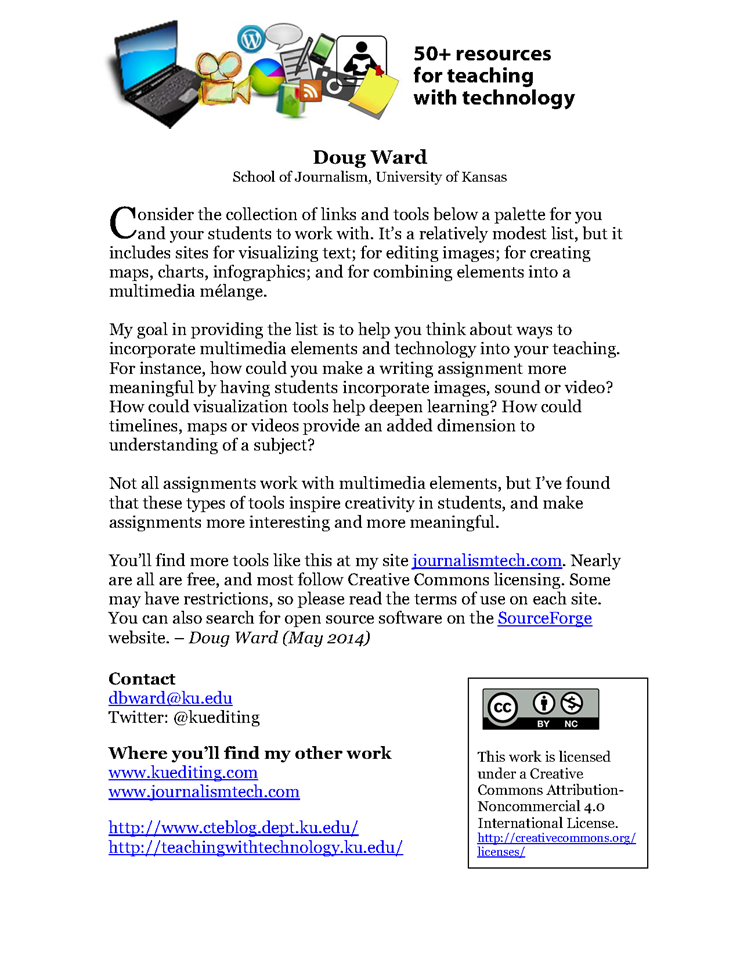 My goal in creating lists like this is to help instructors think about ways to incorporate multimedia elements and technology into their teaching. I never insist that instructors use specific tools. Rather, I try to show how various resources can enrich assignments, deepen learning, expand skills, and make class time more engaging.
Not all assignments lend themselves to multimedia elements, but I’ve found that multimedia tools inspire creativity in students, and make assignments more interesting and more meaningful.
I’ve listed a few tools below. The rest are available in the accompanying PDF.
You’ll find more tools like this at my site journalismtech.com and at Teaching With Technology, a site that Germaine Halegoua and I manage. (This post appears on that site, as well.) Nearly are all are free. Some may have restrictions, so please read the terms of use on each site.
Multimedia tools
- New Hive (site no longer exists). Provides many options to create a single web page with text, images and video.
- ThingLink. Allows you to upload photos and place icons on them that pop up with text, other photos and video.
- Weavly. For creating mashups from YouTube, SoundCloud and other sources.
- Popcorn Maker. A tool for mixing video, audio and images from the web. From Mozilla.
- Meograph. A site for creating multimedia stories.
- Storify. An easy-to-use tool for creating stories from many types of social media.
Timelines
- Dipity. Create timelines, flipbooks, lists and maps. Easy, effective and free for the basic version. One glitch that I’ve found: The embed codes don’t always work well with WordPress sites.
- TimeGlider.
- TimeToast.
Text visualization and analysis
- Wordle. Insert text and create customizable word clouds.
- Document Cloud. Upload documents to the website, analyze them, highlight them and annotate them. You can also create a slideshow-like form that can be embedded elsewhere.
Chart and graph tools
- Many Eyes. Offers tools for creating maps, charts and diagrams, and for analyzing text (word clouds and tag clouds, for example). It offers many examples of how to turn data into visual information. You can input or upload data.
- Chart Gizmo. A free website that allows registered users to create basic charts and graphs.
- Cacoo. Allows you to create and share diagrams, which can be linked, embedded or saved as .png files. More options available with a paid account.
Maps
- Google Maps Engine Lite.
- Google Fusion Tables. Powerful tools for creating maps, charts and graphs. They aren’t difficult to use, but they will take time to learn.
- Community Walk. Based on Google Maps, with some added features.
- MapFab. A useful editor for Google Maps.
Doug Ward is an associate professor of journalism and a fellow at the Center for Teaching Excellence. You can follow him on Twitter @kuediting.
From a variety of disciplines, goals of teaching converge
I’m always surprised at the common themes that emerge when faculty members talk about teaching.
Goals and challenges transcend disciplinary boundaries, allowing for robust discussions about learning; class design and preparation; assessment; the struggles of students, and other areas of teaching.
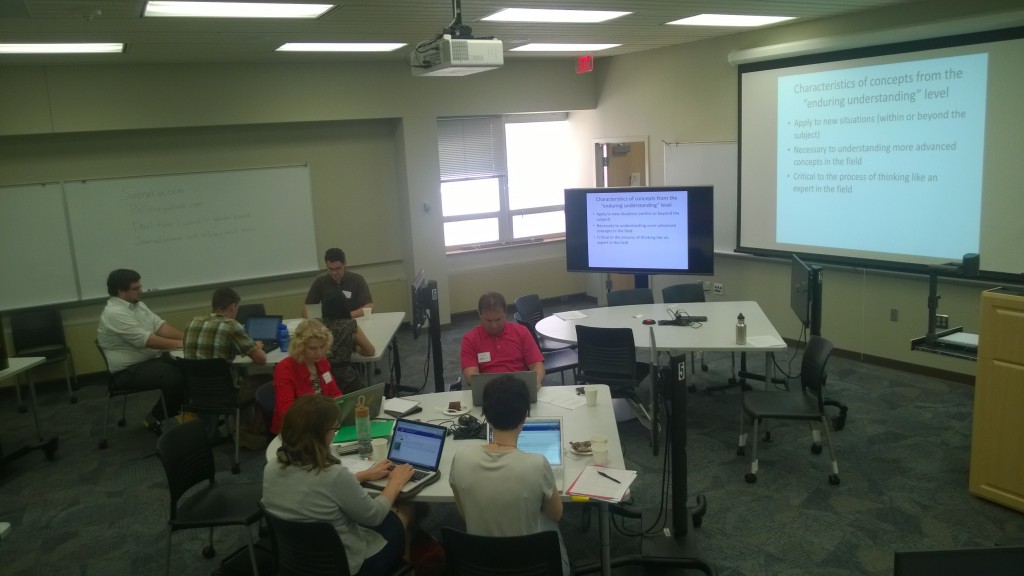
In discussions Tuesday at CTE’s Best Practices Institute, faculty members from a dozen disciplines shared aspirations and strategies for improving their classes. Among the speakers was Meagan Patterson, associate professor of psychology, who explained the key elements of backward design and then asked participants to write down goals they hoped to achieve in their classes.
My table included instructors from pharmacy, philosophy, journalism, and health, sports and exercise science. The overlap among the group was remarkable. As I wrote the goals on a whiteboard, nearly everyone in the group nodded in agreement. They, too, had essentially the same goals. Here’s a distilled list:
- Learn basic course concepts (as in science or philosophy)
- Learn basic definitions and moral principles and apply those to specific situations
- Demonstrate a big picture view of a subject
- Apply knowledge to real world problems
- Demonstrate good persuasive writing and an ability to refute opposing positions
- Make connections to other disciplines and ideas
- Demonstrate an ability to synthesize and explain discrete specialty topics learned in a course.
Identification of goals is only the first step of creating or remaking a class. The bigger challenge comes when a faculty members starts to envision ways for students to learn material and to demonstrate their learning.
That’s part of what makes teaching so enjoyable, though, no matter the discipline.
Doug Ward is an associate professor of journalism and a fellow at the Center for Teaching Excellence. You can follow him on Twitter @kuediting.
Helping students learn the power of math with the power of community
Bozenna Pasik-Duncan specializes in a branch of probability theory called stochastic systems, which views problems through a lens of randomness.
She teaches courses in that area, as well as in subjects like applied statistics, linear algebra and optimization theory.
When faced with a high dropout and failure rate among students in a large 100-level calculus class, though, Pasik-Duncan found a solution in a distinctively humanistic equation: She created a sense of community.
Her methods offer an excellent example of how cooperation among students and instructors can improve learning – and help everyone make friends along the way.
The calculus class that posed the challenge for Pasik-Duncan was Math 121, a 500-person class with several lab sections. In a typical semester, 30 percent or more of the students who enroll eventually withdraw or receive a D or an F. In university parlance, that’s known as the DFW rate, a statistic that administrators follow closely.
To address that problem, Pasik-Duncan urged collaboration from the first day of class. Everyone was expected to collaborate: the instructor, the teaching assistants and the students.
Collaboration was just the beginning, though. She promoted the idea of “C to the power of five”: collaboration, community, connection, curiosity, and connectivity.
“Always interpret,” she told students. “Always question. Why, why, why, why do I need to know that?”
About a quarter of the students in the class struggled with concepts like derivatives, domains, integrals and arc lengths. A quarter of the students, many of them from outside the United States, excelled at calculus. So Pasik-Duncan struck a deal. She asked for volunteers to help the struggling students and said she would write letters explaining their role in helping others succeed.
“We’re a community. Let’s help each other,” Pasik-Duncan told students. “At this moment, you need my help. Next semester, I may need your help.”
Students loved it, she said. Not only did they make connections among concepts in the classroom, but they made connections with other students. The DFW rate in her class fell to less than 14 percent, less than half the typical rate.
And not only did the struggling students improve in math, but the international students who struggled with English found that the one-on-one interactions with fellow students helped them improve their language skills.
“I consider this a beautiful thing,” Pasik-Duncan said. “On top of teaching and learning, we also have this community service.”
And the power of community.
Doug Ward is an associate professor of journalism and a fellow at the Center for Teaching Excellence. You can follow him on Twitter @kuediting.