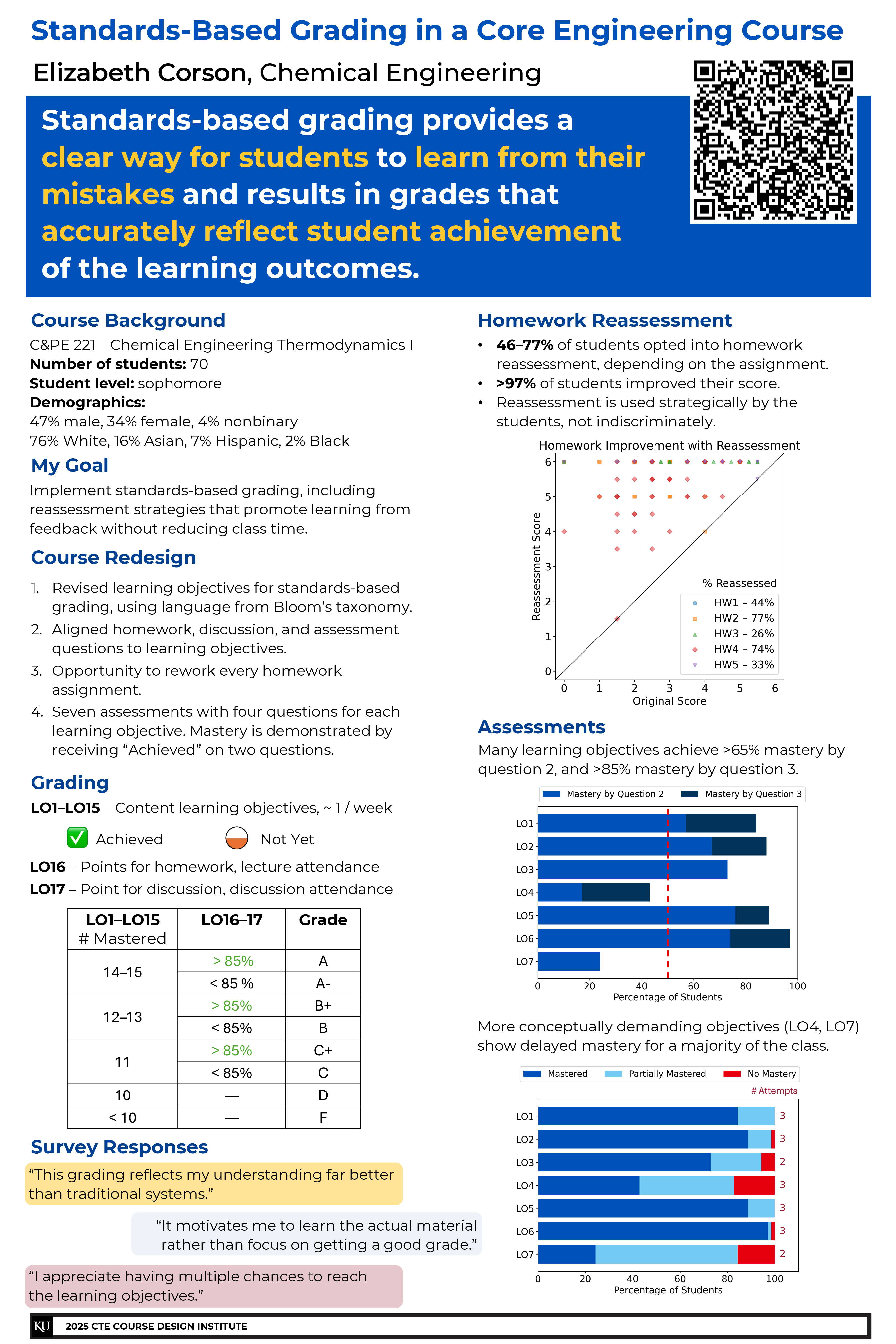
Standards-Based Grading in a Core Engineering Course
How Can This Help
For the First-Year Instructor:
This poster provides a blueprint for moving away from manual, point-heavy grading toward a mastery-based model. It shows how to use reassessment strategies to reduce student frustration and provide clearer feedback.
For the Department Chair:
This redesign demonstrates a scalable approach to improving student outcomes in core engineering courses. By aligning assessments with Bloom’s Taxonomy and utilizing data-driven mastery thresholds, this model offers a measurable way to increase retention in high-stakes subjects.
Poster Spotlight | 2026 CTE Course Design Institute
Elizabeth Corson, assistant professor in Chemical & Energy Engineering, wanted grades in Chemical Engineering Thermodynamics (C&PE 221 and 721) to reflect what students understood, not just how many points they earned. Her redesign aimed to shift the focus from memorizing material for a test to demonstrating mastery.
Through the Course Design Institute (CDI), Corson redesigned her course around what students needed to learn, how they could practice, and how they would demonstrate mastery.
What changed
Three changes guided the redesign:
- Bloom’s Taxonomy Alignment: Learning objectives were rewritten to focus on specific cognitive actions rather than vague content coverage.
- Strategic Reassessment: Students could rework every homework assignment, giving them another opportunity to demonstrate what they had learned. The draft reports that 97% of students improved their scores and that students chose reassessment opportunities selectively.
- Mastery Thresholds: Students demonstrated mastery of a learning objective by earning an “Achieved” rating on two of the four questions tied to that objective. This gave Corson a way to track progress toward individual objectives rather than relying only on a total score.
The results
46–77% of students opted into reassessment with the majority achieving mastery by the second or third question of most objectives.
How students responded
Student feedback that was collected indicated a shift in motivation. Students reported a deeper focus on learning the material rather than just chasing a letter grade.
Resources for Other Instructors
Along with the poster, Corson developed supplemental resources to help other faculty use this approach to assessing learning. Her toolkit includes training and tutorials along with example grade trackers, exam templates and a course schedule. Download the supplemental resource guide.