By Doug Ward
How do we adapt online courses to generative artificial intelligence?
That’s the question we asked about a dozen instructors, instructional designers, and educational technology specialists to grapple with this semester.
Through a series of discussions we called a CTE Innovation Lab, they worked at identifying the major challenges in online education and considered how we might approach online teaching in more effective ways and how generative AI might help us overcome some of the problems it has created.
I came away from each discussion energized by the contributions of thoughtful colleagues who approach teaching with determination and humility. They value the intellectual development of their students and put learning at the core of everything they do. They are succeeding despite structural barriers, yet they remain concerned and frustrated.
Members of the group did not identify any single strategy for success. We all knew that was impossible, given the complexities of generative AI and the conflicting incentives and barriers that students and instructors face. We did clarify the challenges and identify potential paths for exploration in the near and long term. I’ll go into more depth about those in later articles. For now, here are some of the issues the group discussed and the ideas that emerged. Some of the synopsis takes the form of infographics I created with the help of Google’s Gemini.
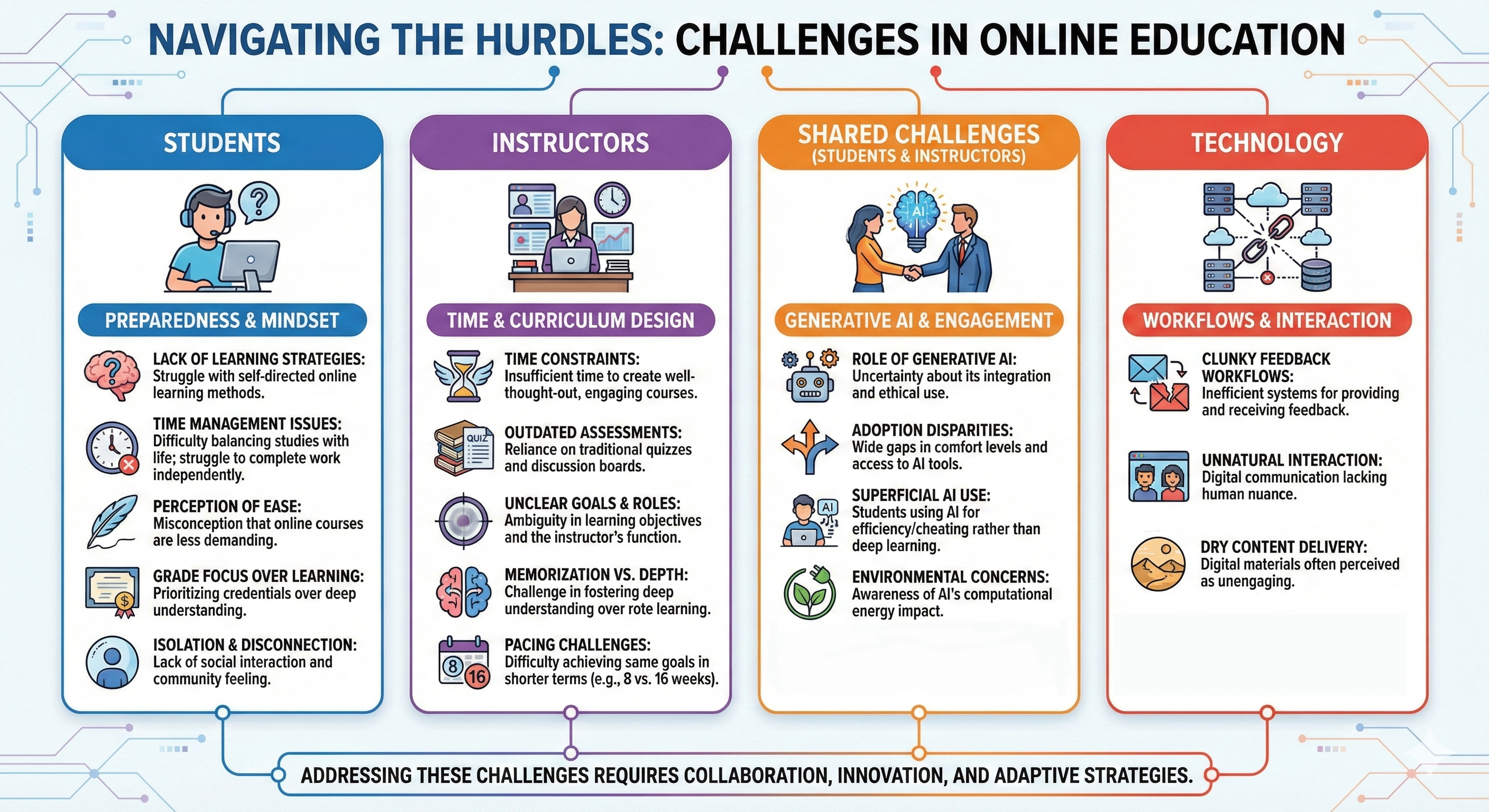
Design constraints make change difficult
Online education has enormous value, and it provides important options for students. It also comes with restraints that make meaningful change difficult. Among those constraints:
- Scale. Online classes work best when they are small enough that instructors can get to know students and provide regular, meaningful feedback. That runs counter to an administrative desire for larger classes.
- Time (instructors). Instructors and instructional designers lack the time and resources to make widescale changes and experiment with new tools.
- Time (students). Students value the flexibility of online courses. Undergraduates, though, often don’t invest the time or effort that online courses require or have the organization and time-management skills they need to succeed.
- Tools. Canvas has many limitations, and instructors lack access to outside tools that could help.
- Generative AI. The rapidly changing nature of AI requires us to build flexible courses we can adapt quickly and frequently as technology, students, and circumstances change. Instructors, who have deep disciplinary skills, rarely have the technological skills that AI often requires.
We must view AI as infrastructure, not an add‑on
Rather than fighting generative AI, we must embrace it as a means of extending our abilities as instructors and instructional designers. This includes integration of AI literacy into courses and use of tools to engage students, save time, and improve learning:
- AI assistants and chatbots inside courses
- Agentic AI tied to Canvas
- Automated or semi‑automated student outreach
- AI‑supported grading and feedback
AI shifts effort; it doesn’t save time
Generative AI has shifted where instructors spend their time. It can save time in some areas, but it creates new types of work, and any time savings is more than offset by:
- redesigning assignments
- monitoring student assignments and deciding how much AI is too much
- learning AI logic and refining prompting techniques
- developing and troubleshooting potential new tools
- integrating new platforms and developing strategies to improve them
- monitoring AI output, which is often glitchy and unreliable
- monitoring costs of metered tools
- weighing benefits against risks, especially when introducing AI tools into classes
Assessment must emphasize process and judgment
Generative AI excels at completing the types of structured assessments we have used for decades. We need to find ways to center judgment as a critical skill and emphasize the process of learning. That means articulating the thinking and decision-making that students need to master, making clear how assignments help students build those skills, and finding ways to assess those skills (which include when to use or not use AI).
We are struggling to find solid solutions because we are in the middle of enormous changes and have yet to clearly articulate what higher education in an AI era might look like. We need to continue to experiment with approaches like:
- reflection assignments that accompany traditional assessments
- alternative grading
- competency‑based assessment
- requirements for students to evaluate and justify AI-generated materials
- interactive case studies that adapt to decisions students make
- authentic assignments, which apply skills to real-world problems and often take learning outside classes
- projects that help students iterate skill development
- learning portfolios, which allow students to demonstrate their skills through work and reflection
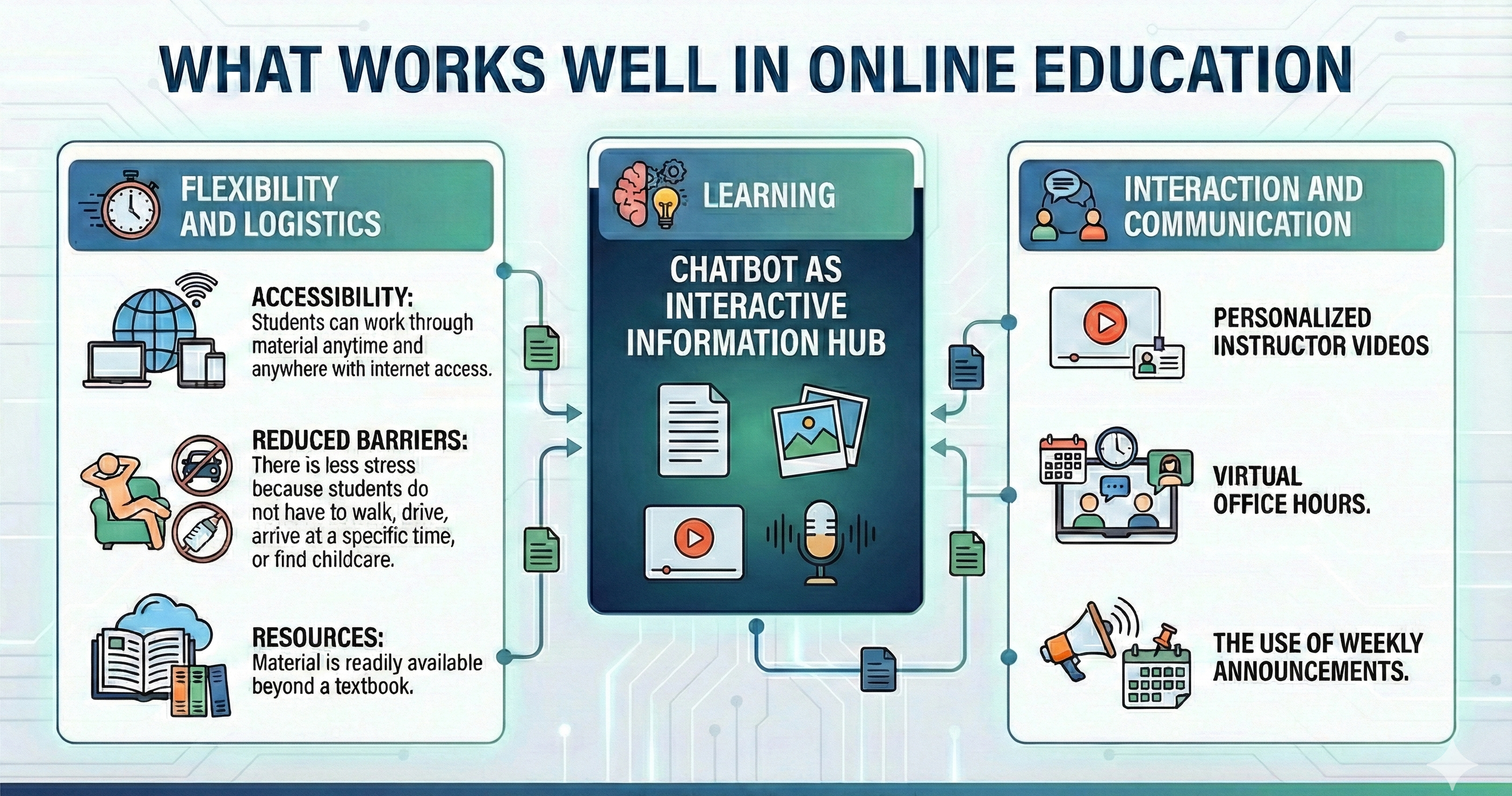
Ideas for moving forward
We identified several promising areas during our discussions and experimentation, but all will take additional work.
Class assistants. A psychology instructor piloted a Socrative AI assistant we created at CTE, and it drew mostly positive comments from students. It had considerable use over several days before an exam, with students using it to better understand concepts, create study materials, and get feedback. CTE has created similar assistants for other classes, and we will continue to refine those tools.
Oral checks on learning. Many instructors in in-person classes have found these successful, and we considered ways to take a similar approach online, including videoconference check-ins and use of AI-infused tools like Riff to gather asynchronous reflection. (CTE has created a check-in system that can also help. More about that soon.)
Structured reflection. This can be integrated into assignments or as stand-alone assignments connected to student-set learning goals. It allows students to articulate goals, develop metacognitive skills, connect concepts across courses, and engage in end‑of‑course synthesis. This produced deeper engagement and clearer evidence of learning than many content‑driven activities.
AI-generated syllabus podcasts. Few students actually read a course syllabus, and many instructors give quizzes over a syllabus or create scavenger hunts to guide students to important course policies and procedures. AI-generated podcasts could offer another option. We found those podcasts, generated by NotebookLM or Copilot, engaging and potentially helpful.
Replacement for discussion boards. Discussion boards have been a staple of online courses, but generative AI has made their effectiveness questionable. Some instructors have had success using social annotation tools like Hypothesis or Perusall instead. Others have tested a platform called Breakout Learning, which uses AI to analyze oral discussions online, and Muzzy Lane, which uses AI to assess role-playing scenarios. Those platforms come with additional costs, which means that their best features are unavailable or that students must pay additional fees each semester.
Improved communication. We agreed that we needed to find more effective ways to communicate with students. Canvas lacks interactive tools for developing meaningful connection, and email is low on most students’ priority list. Text messaging could help, and Teams has potential if we can get students to adopt it.
Final thoughts
The only way to improve online education is to improve connection and motivation among students. We must improve communication, increase interactivity, and make skill development clear and meaningful. Digital tools can help, but they can’t replace good pedagogy and an engaged instructor. Students must feel a sense of belonging, and both instructors and students must build trust.
In other words, human skills remain the foundation of effective learning.
We will continue to share examples, tools, and ideas in the coming months.
Doug Ward is associate director of the Center for Teaching Excellence and an associate professor of journalism and mass communications.